

COLLEGE STATION, Texas — The Manufacturing University Initiative for Qualification & Certification (MUI-QC) represents a continued collaborative partnership between Los Alamos National Laboratories (LANL) and Texas A&M University (TAMU).
The MUI-QC program, initially funded by the TAMU Nuclear Security Office, is dedicated to advancing nuclear technology maturation by supporting both faculty and students. This program encourages students to develop projects that enhance nuclear science, working closely with TAMU faculty and their counterparts at LANL.
Don Lipkin, a Professor of Materials Science and Engineering at TAMU, works alongside Amy Clarke, a Metallurgical and Materials Engineer for LANL, to guide material science projects. For technology development, Satish Bukkaptnam, the Department Head of Industrial and Systems Engineering at TAMU, collaborates with John Bernardin, the President of Engineering and Technology Instruction and an R&D Engineer at LANL. Lastly, for testing and evaluation projects, Pablo Tarazaga, a Professor of Mechanical Engineering at TAMU, and Cristian Pantea, an Applied Acoustics Research Scientist at LANL, work alongside students.
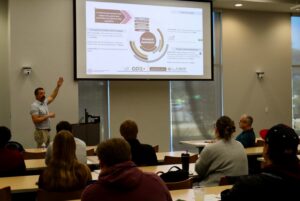
By fostering these connections, the program accelerates technological advancements while preparing TAMU students to become future nuclear science innovators. This collaborative effort not only inspires students to engage in meaningful projects during their time at TAMU but also opens the door to rewarding opportunities within the LANL workforce.
MUI-QC also provides a new perspective on nuclear energy science and the manufacturing process as a whole. It emphasizes the interconnectedness of materials, technology, and testing and evaluation, viewing these elements as integral components of a unified innovation cycle rather than isolated fields.
Advancements in material understanding are critical to meet the growing demands of modern applications. While developing new technologies is essential to effectively use these materials in production processes. Finally, enhanced testing methods are necessary to ensure that these innovations perform reliably. Collectively, these advancements propel nuclear energy science forward and refine existing methodologies.
Since the ultimate goal of the MUI-QC program is to advance scientific knowledge, foster innovation, and embrace future possibilities, TAMU is the ideal partner to work alongside LANL and drive scientific progress.
The university excels in material science, discovery, and design, which are pivotal for enhancing LANL’s capabilities. By deepening the study of material science, LANL can uncover new insights that address the constraints imposed by traditional materials and outdated techniques. This understanding is crucial to advance the nuclear enterprise’s mission, which focuses on enhancing energy production while ensuring safety and efficiency.
Moreover, TAMU has established strong research and development foundations in both additive and subtractive manufacturing processes. The systems developed encompass a wide range of manufacturing techniques, including metal and hybrid methods. These also incorporate advanced multimodal monitoring, embedded cybersecurity markers within the supply chain, and modeling of thermomechanical processes. These developments enhance the nuclear enterprise’s capabilities, paving the way for innovative production and improved component reliability.
TAMU’s capacity to test and validate systems at various scales is a unique and significant asset. The university hosts world-class facilities that support this function. Additionally, through the long-standing partnership between TAMU and LANL, both institutions have cultivated complementary skills in material characterization and environmental testing, which are essential to address LANL’s evolving needs. The capabilities developed enable comprehensive evaluation across multiple scales, which is vital for ensuring system integrity and performance.
In conclusion, the MUI-QC program is working to enhance the development of new materials, technologies, and processes essential to advance nuclear enterprise solutions. The program not only prepares TAMU students for careers in nuclear science but also positions both TAMU and LANL at the forefront of scientific research and applications, proving that successful academic-industrial collaboration can drive innovation.