COLLEGE STATION, Texas — From nuclear engineering to advanced robotics, graduate researchers at Texas A&M University are advancing the frontiers of technology through the Texas A&M University System-Los Alamos National Laboratory (TAMUS-LANL) Fellowship Program — a partnership that merges academic excellence with national service.
The fellowship, jointly sponsored as part of the strategic partnership between the Texas A&M University System and LANL, provides graduate students across the System with the opportunity to collaborate directly with researchers at Los Alamos National Laboratory, one of the nation’s premier scientific institutions. Students work on projects that strengthen America’s national security capabilities, and scientific leadership.
Autonomy Meets Safety: Robotics in Hazardous Environments
In the Land, Air and Space Robotics (LASR) Laboratory, Texas A&M doctoral student Nathan Long is designing technologies to enhance safety in hazardous environments. His project, developed with Dr. Beth Boardman and the Automated Drum Retrieval and Storage System (ADReSS) team at Los Alamos, centers on the Autonomous Nuclear Environment Utility Transport & Retrieval Operations Node (A-NEUTRON) — an autonomous robotic system built to handle radioactive or otherwise potentially hazardous materials safely and efficiently.
“It’s fantastic being able to leverage the resources of the LASR Lab here at Texas A&M while performing this novel work for LANL,” Long said. “Our resources let me prototype at a much faster pace than would be possible otherwise, which results in more important work being done for LANL.”
Long hopes his research as a TAMUS-LANL Fellow will help LANL refine autonomous guidance algorithms to improve logistics and materials handling in high-risk environments. “I’m honored to represent Texas A&M in this strong relationship between two incredible institutions,” he added.
Computational Advances in Nuclear Engineering
In Texas A&M’s Department of Nuclear Engineering, Jason Rodriguez, a multi-degree Aggie, is developing new computational models to accelerate nuclear research. His project, which was specifically selected for funding by the LANL Engineering Institute, focuses on building a fast surrogate model to compute the response of helium-3 neutron detectors to non-stationary volumetric neutron sources, leveraging Texas A&M’s open-source simulation engine OpenSn.
“The adjoint method we’re applying allows for rapid and accurate evaluation of detector responses — in seconds rather than hours,” Rodriguez explained. “When mathematics evolves from symbols on a page into equations that produce physically interpretable results, it feels as though I’m contributing to the long history of scientific efforts that expand our understanding of the physical world.”
Rodriguez hopes his experience as a TAMUS-LANL Fellow will help build a career at a national lab, continuing to advance reactor modeling and nuclear systems analysis. “Learning to conduct scientific research at the level demanded by the American nuclear enterprise is an invaluable experience,” he said.
Engineering Materials for the Future
For Mahtab Heydari, another TAMUS-LANL Fellow at Texas A&M, the program provides the opportunity to merge cutting-edge experimentation with national-level impact. Her research involves the development and characterization of advanced materials using laser-based diagnostic systems to better understand material performance under extreme conditions — data critical to nuclear science and national security applications.
Working with advanced lab equipment, Heydari performs laser and imaging experiments that help researchers visualize micro- and nanoscale behaviors in engineered materials.
“This fellowship allows me to work at the intersection of fundamental science and applied engineering,” she said. “Having access to both the facilities at Texas A&M and the expertise at Los Alamos gives me the tools to make meaningful contributions to both.”
Additive Manufacturing and Shape Memory Alloys
Adelynn Belle, another TAMUS–LANL Fellow, is using computation to redefine manufacturing science. Her research focuses on developing a computational model for the additive manufacturing (AM) of shape memory alloy (SMA) lattices, simulating the full process of laser powder bed fusion — a metallic 3D printing method — to predict the as-printed properties of complex components.
“Additive manufacturing can significantly alter material properties and induce warpage in a component,” Belle explained. “With my model, performance analysis can accurately consider the as-printed characteristics.”
Belle said the fellowship helped her gain both confidence and professional visibility. “The fellowship offered me the opportunity to participate in my first internship and present at a conference,” she said. “Presenting my work and collaborating with professionals helped me realize I belong in this community of researchers.”
The experience has inspired her to pursue a long-term career in research. “I’d be happy working at LANL one day,” she said. “The fellowship has provided me with lasting connections and future funding opportunities to help me continue forward.”
A Collaboration that Builds the Future
The Texas A&M University System–Los Alamos Fellowship Program exemplifies how collaborative research between academia and the national laboratories can accelerate discovery and cultivate the next generation of innovators. Fellows gain access to world-class resources, mentorship, and research experiences that align with both academic goals and national priorities.
Whether designing autonomous systems, advancing nuclear modeling, or developing resilient materials, these TAMUS-LANL Fellows are contributing to the same mission that drives both institutions: applying science and engineering to make the world safer, smarter, and more secure.
++++++++++++++++++++++++++++++++++++++++++
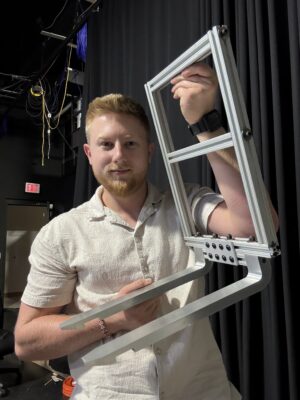
Photo: Nathan Long, Ph.D. student at Texas A&M University and TAMUS-LANL Fellow displays some of the research he is doing at the Land, Air, and Space Robotics (LASR) laboratory at Texas A&M. (Photo provided by Nathan Long)
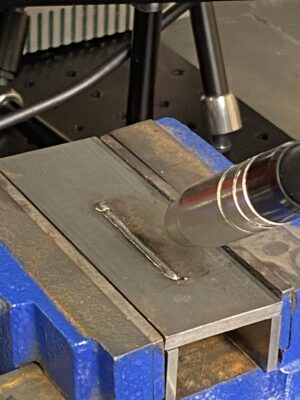
Photo: Melt pools produced by welding are analyzed through neuromorphic event images in Mahtab Heydari’s research as a Ph.D. candidate and TAMUS-LANL Fellow. (Photo by Patrick Seiber, TAMUS Nuclear Security Office)
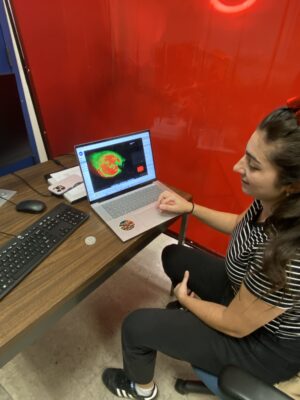
Photo: Mahtab Heydari, a Ph.D. candidate and TAMUS-LANL Fellow, analyzes neuromorphic event images of melt pools produced by welding for anomaly detection as part of her research at Texas A&M University. (Photo by Patrick Seiber, TAMUS Nuclear Security Office)
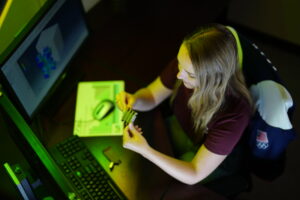
Photo: Adelynn Belle, Ph.D. student at Texas A&M University and TAMUS-LANL Fellow developed a computational model for the additive manufacturing of shape memory alloy (SMA) lattices through 3D printing. (Photo provided by Adelynn Belle)
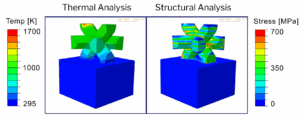
Photo: Graph of Adelynn Belle’s computational model for the additive manufacturing of shape memory alloy lattices. (Image provided by Adelynn Belle)

Photo: Adjoint source-driven (He-3 detector) neutron flux distribution in a mock-up glovebox (Photo provided by Jason Rodriguez)