
By Katherine Hollen
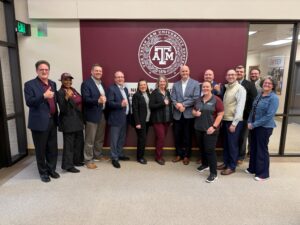
COLLEGE STATION, Texas — On February 17th and 18th, Pantex executives traveled from Amarillo to College Station to participate in a technical exchange forum with the Texas A&M University System, hosted by the Nuclear Security Office (NSO).
The Pantex Plant is a vital component of the National Nuclear Security Administration’s Nuclear Security Enterprise. As an essential production facility, Pantex ensures the reliability, safety, and effectiveness of the U.S. nuclear stockpile, thereby reinforcing the nation’s deterrence strategy.
Pantex is engaged in a variety of crucial activities, such as the assembly and disassembly of nuclear explosives, testing and evaluating nuclear materials, and manufacturing and assessing high explosives. Pantex’s work also supports the longevity of nuclear weapons by serving as a retrofit and life-extension center.
Evelyn Mullen, Associate Vice Chancellor for Nuclear Security Initiatives, remarked how the technical exchange forum, “driven by a shared commitment to national security, allowed the Texas A&M University System to showcase, at a strategic level, examples of ongoing research, development, and training activities and how the A&M System can support Pantex’s mission interests.”
The Pantex executives were welcomed to the forum by Executive Vice Chancellor of the Texas A&M University System, Susan Ballabina, Vice Chancellor for Nuclear Security Initiatives of Texas A&M University System, Dr. Diane Hurtado, and the Vice Chancellor for Engineering, Dr. Robert Bishop. They then had the chance to engage in focused discussions with several engineering departments. Leaders from Engineering Technology and Industrial Distribution, Industrial & Systems Engineering, Mechanical Engineering, and Materials Science and Engineering offered valuable insights into their research. Pantex shared current mission needs and ideas aimed at aligning academics with the evolving demands of the industry.
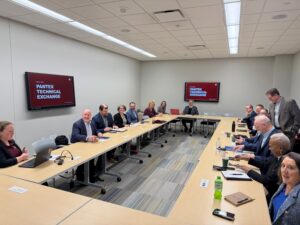
Pantex’s Division Director for Production Operations, Dr. Carl Beard, described the goals of the partnership, saying, “The Texas A&M University System is one of our strategic partners. Our goal is to leverage the world-class intellectual and physical capabilities of the University System while engaging students at all levels with the hope that many will become future employees. Through these efforts, Texas A&M helps us deliver on our national security mission now while helping us prepare for the future.”
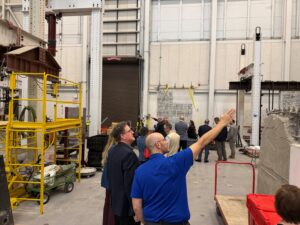
The visit also included engagement and tours with the following organizations that have applicable research and operational expertise:
The Fischer Engineering Design Center (FEDC) showcased an important facility that offers students hands-on experiences. The FEDC is designed for undergraduate engineering students, providing access to advanced tools, equipment, and high-quality materials to bring their ideas to life. In this dynamic environment, students engage in creative projects within design studios, fabrication centers, and instructional labs, all while honing new, innovative skills. This preparation equips students for future work opportunities at production facilities such as Pantex.
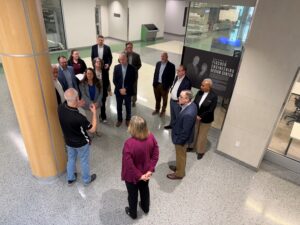
The Shape Memory Alloy Research Team (SMART) Lab, headed by Dr. Satish Bukkapatnam, works to develop experimentally validated models for Shape Memory Alloys (SMAs), a material that can return to its original shape after deformation. The SMART lab also seeks to improve the design of “smart” structures that use SMAs to control their shape and movement. On the tour, graduate students who work in the lab discussed ongoing projects, including the use of improved AI prediction models to support smarter, data-driven methods for understanding and qualifying printed metal parts without damaging them. This innovative approach aligns well with Pantex’s desire to advance and mature materials.
The School of Public Health’s Department of Environmental and Occupational Health shared research dedicated to enhancing occupational safety by developing and implementing strategies to reduce the risk of workplace injury and illness. Their efforts include reducing worker stress and designing personal protective equipment that accommodates all body types, with a particular emphasis on improving body armor tailored for women. They also devise solutions to minimize harm, motivate employees, promote their well-being, and create healthier work environments, which can support production agencies like Pantex in maintaining safe work conditions.
The Mays Business School at Texas A&M is actively working to integrate Artificial Intelligence (AI) into its student curriculum. Focusing on innovation, the program equips students with the skills necessary to thrive in an AI-driven environment. The school hopes to create a new generation of students ready to take on the opportunities and challenges that come with AI as it continues to grow. Through this curriculum, students will learn to use AI effectively and efficiently to advance their careers, hopefully bringing new perspectives to national security missions in critical business operations.
College Station is also home to the Texas A&M Engineering Extension Service’s (TEEX) Brayton Fire Training Field, Disaster City, and the Emergency Operations Training Center (EOTC). The Pantex executives had the opportunity to tour all the facilities. The TEEX Brayton Fire Training Field provides training stations to thousands of first responders, while Disaster City features full-scale wreckage and destroyed structures that simulate real disasters. The EOTC houses classrooms, meeting rooms, and a broadcast room, all designed for various groups to train their personnel in crisis management. Together, these facilities foster emergency management skills and promote a unified team approach. The training capabilities offered here are directly applicable to national labs and Pantex, which must prepare for emergencies and disaster response scenarios.
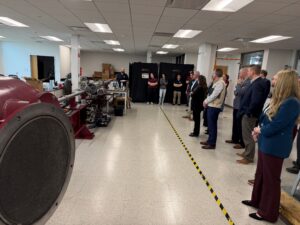
Finally, Pantex executives made a stop at the Turbomachinery (TURBO) Lab. Here, researchers study how materials respond to extreme thermal and mechanical changes, essential for understanding performance under severe conditions. They focus on engineered systems to prevent detonations, examining the physics behind ignition and explosions. The lab also designs and optimizes chemical propellants to achieve specific ballistic outcomes through careful fuel selection and experimental validation. The TURBO Lab advances the understanding of critical materials and systems for defense and safety, supporting Pantex in their national security mission.
In conclusion, the technical exchange forum between Pantex and the A&M System highlights the collaborative efforts between national security and higher education. The numerous innovative labs and research initiatives at the A&M System hope to play a crucial role in further supporting Pantex’s commitment to nuclear deterrence. Now, as both institutions continue to work together, they will strengthen the safety, reliability, and effectiveness of the nation’s nuclear stockpile.