By Katherine Hollen
Researchers in the Department of Environmental and Occupational Health at the Texas A&M University School of Public Health work to improve the well-being and safety of workers across various industries, including the nuclear sector. Their investigations into occupational health advance knowledge, enhance individual health and safety, reduce harm, improve working conditions, and support workers across diverse environments.
One such researcher is Dr. Jay Kim, whose current work focuses on exoskeleton technology designed to alleviate biomechanical stress associated with labor-intensive tasks. “An exoskeleton is a wearable assistive device that provides support to reduce physical strain, especially during prolonged postures or physically demanding tasks,” says Dr. Kim. “If you have to do repetitive lifting, it provides support, so you may not need to exert as much force as you normally do.”
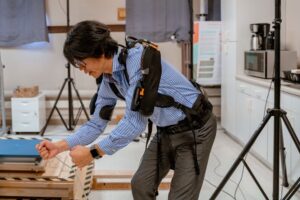
His work is particularly important because it addresses the alarmingly high rates of musculoskeletal injuries across sectors such as agriculture, commercial fishing, forestry, and construction. The physically demanding nature of these jobs, often conducted in challenging conditions, contributes to the risks that workers face.
For instance, commercial crab fishing pots weigh about 150 pounds when empty. With the addition of weights, bait, and crabs after a catch, they can weigh up to 500 pounds. Fishermen often work in teams of two to lift hundreds of pounds, sometimes more than a thousand times a day. Exoskeletons have been implemented to provide lower back support and relieve strain among these fishermen.
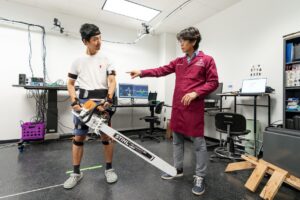
Dr. Kim has also recently completed both lab-based and field studies on the use of exoskeletons in manual timber felling. While much of the timber industry has mechanized, areas in the Pacific Northwest feature steep terrain where manual felling remains the only viable option, as machinery cannot access such slopes. Manual timber fellers often experience strain from bending and from wielding heavy chainsaws while repeatedly cutting down trees. The exoskeletons have been shown to help alleviate shoulder and lower back strain.
When discussing how this technology could be applied in nuclear settings, Dr. Kim states, “Their [nuclear workers’] tasks are no different from maintenance and construction in other fields. There is a lot of manual handling, and some structures require four people to lift them. So, I think these exoskeletons could be useful for such tasks, as we have observed in other sectors.”
In addition to enhancing worker safety, exoskeletons could also increase operational efficiency. By reducing the physical strain associated with heavy lifting and repetitive tasks, exoskeletons help prevent injuries and enable workers to perform maintenance more comfortably. They could also facilitate team operations, allowing small groups to manage heavier loads more efficiently. Additionally, by increasing productivity and fostering a safer work environment, exoskeletons could lead to long-term cost savings.
Dr. Kim hopes his work will lead to the implementation of exoskeletons as an ergonomic intervention to reduce musculoskeletal injuries. He will continue to evaluate the effectiveness of these exoskeletons in reducing injury rates, seeking to enhance the health and well-being of workers who use them in the nuclear sector and beyond.