By Katherine Hollen
Dr. Andrea Porter is not only a recent Texas A&M University graduate, having earned her PhD in Interdisciplinary Engineering in 2025, but she is also a distinguished TEDxTAMU speaker. Dr. Porter beat out hundreds of other applicants to become one of only seven Aggies to take the stage at the event. After months of preparation, writing and memorizing her presentation, she discussed her groundbreaking work on making armor more comfortable for women, the critical role bras play in this endeavor, and the urgent need for better-designed personal protective equipment (PPE) for women.

The Inspiration
Dr. Porter’s journey began in Amarillo, Texas, where she lived for many years with her husband, who was a teacher in the local school district. This district served a diverse student population, many of whom came from economically disadvantaged families. Although Dr. Porter was not a teacher, she actively participated in school events alongside her husband. She served as a mentor to many students, particularly young women who lacked professional female role models. After graduation, many of these students sought careers in the military and later in the police force to quickly start earning a living. But even after leaving school, several students kept in touch with Dr. Porter, sharing stories about their experiences, including wearing armor for their new jobs.
Through her correspondence with these young women, Dr. Porter became increasingly aware of the issues they faced with ill-fitting body armor. They shared their frustration, and she says they wrote to her about “How badly the body armor hurt their bodies and how it limited their ability to do field exercises and their jobs well.” Given that armor is often designed with larger men in mind, there are few appropriately sized options available for petite women. Dr. Porter says that her concern for these young women she mentored drove her to approach Dr. Mark Benden, the Department Chair for Environmental & Occupational Health and Director of the Center for Worker Health. She recalls, “I told him that I would really like to work on a solution to this problem. Thankfully, he was on board!”
The Issue
Women experience a wide array of injuries due to poorly fitting armor. When armor is too wide for their shoulders, they often have to seat their weapons on their biceps rather than in their armpits, which can cause bruising. Police vests typically weigh 25-35 pounds, while military vests can weigh up to 40 pounds. Men’s upper-body muscle mass allows them to easily carry these loads on their shoulders, back, and chest, but women have more muscle mass in their hips and legs to carry weight. As a result, heavy vests can cause nerve and muscle damage, leading to a reduced range of motion. Ultimately, poorly fitting armor significantly impairs women’s ability to perform at their full potential.
Consequently, Dr. Porter began her project by focusing on the ergonomics of PPE for women, aiming to enhance their comfort, safety, and productivity. “It was not so much about designing armor as it was about figuring out how to make them comfortable while wearing it,” Dr. Porter says. Every day, thousands of women wear armor as part of their uniform, which means they constantly endure discomfort from ill-fitting gear.
The Role of Bras
About 70% of the general female population experiences regular breast pain. In her dissertation research, Dr. Porter found that women law enforcement officers experienced breast pain at a higher rate. She also discovered one unexpected solution: that helping women feel more comfortable starts with improving the fit of their bras. “It is really about the bra and fitting the bra to the body so that the armor then fits better,” informs Dr. Porter. “It is also about educating people on what actually fits and what works for their body.” As a result, Dr. Porter has since founded her own business, the Brazos Bra Co., which grew from her work at A&M. Now she educates women and offers sports bra fittings to help individuals find bras that complement their unique bodies.
Dr. Porter engages with many different women through her work. She talks with female athletes and their trainers, as the subject of bras is often neglected in sports discussions. She also speaks with professionals who wear armor and other torso-borne PPE, even offering advice on how to better position their equipment. But no matter who she works with, Dr. Porter’s goal is to give women essential bra knowledge. “I familiarize them with what they should be looking for, how a good fit should feel.” She says that “Most people have no idea what it should feel like, because there is fashion and then there is the actual fit and purpose of the bra. I have to teach on the actual fit and purpose.”
Beyond Comfort
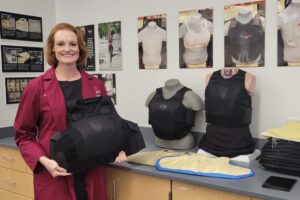
Although Dr. Porter has already graduated with her PhD, her work is far from over. She is dedicated to the continued advancement of women’s PPE. Now shifting their focus beyond ergonomics, she is concentrating on enhancing armor protection for women. Dr. Porter says that most testing is conducted by shooting armor placed against a flat block of clay for ballistics evaluation. However, this approach is ineffective for women. The female torso is not flat like a block of clay; it has curves that significantly influence how ballistic impacts affect armor performance.
Dr. Porter emphasizes, “I hope that my research increases the testing done on a simulated human torso wearing armor. Every other test uses a flat clay block rather than the contour shape of an actual female or even a male. So, that is what I want my research to change: that we do not test on flat blocks.”
National Security Connection
Dr. Porter also hopes her research will benefit the nuclear and national security sectors. One example of PPE that needs improvement for women is lead aprons or lead vests used to protect users from radiation. These heavy aprons place undue weight on the breasts, which are only attached to the chest wall by fine musculature, making this area unsuitable for bearing heavy loads. The work Dr. Porter is doing could lead to the development of new lead aprons better designed for female employees.
Having previously worked in the nuclear sector herself, Dr. Porter served as a human factors intern at Pantex. During her time there, she engaged with several employees, including a female special forces officer, to discuss their equipment. “Her armor was heavy,” Dr. Porter recalls, remembering how the officer shared her experience. “I asked her how she had gotten used to it after working there for 20 years. And she said that it hurts her, but she is not going to complain because it is all men, and it is not okay to complain if you are a woman.”
With equipment being designed for men and hardworking women struggling to keep up, the implementation of armor and other PPE designed for women could improve the retention of women not only in national security organizations but also in all protection and security fields. As Dr. Porter notes, once the body begins to break down, most people will not remain in a job that actively harms them. By advancing PPE, she firmly believes retention and career longevity can be significantly improved, helping prevent women from retiring early due to ill-fitting equipment and fostering greater inclusion.