By Katherine Hollen
Many of us are familiar with the movie Star Wars, and watched how the human characters interact and converse with robots throughout the movie. But while that is in the movies, what does it look like in real life? The Robotics and Automation Design (RAD) Lab, led by Dr. Robert Ambrose, Associate Agency Director of Texas A&M Engineering Experiment Station (TEES), along with other faculty, staff, and students, works to create and deploy tailor-made robots that can withstand harsh, extreme environments, both on Earth and in space. The RAD Lab also works to ensure safe, exploratory collaboration between humans and robots.
Before joining A&M, Dr. Ambrose was the Chief of the Software, Robotics, and Simulation Division at NASA’s Johnson Space Center. He was invited to A&M to establish a space robotics program, which resulted in the creation of the RAD Lab. Located primarily in the Research Integration Center, built five years ago on the RELLIS campus, the RAD Lab adopts a synergistic approach that integrates space exploration with national security.
Rovers
The RAD Lab is engaged in a wide array of robotics projects, including one focused on redesigning wheeled rovers. Traditional rovers combine steering and driving into a single system, which limits their maneuverability. Typically, these vehicles operate with a single engine powering all wheels, using common torsion bars to couple wheel movement. In contrast, each wheel on the RAD Exploration Vehicle (REV) operates with three degrees of freedom (drive, steer, and suspension) with its own electric motor, enabling precise control of direction and movement. This also provides each wheel with the ability to drive, rotate, and lift/lower independently. This innovative design not only enhances the rover’s balance and traction but also improves its ability to navigate across challenging terrain.
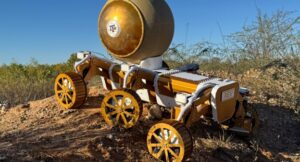
Rovers can also assist the military. Currently, tanks and armored vehicles must stop for 15 minutes to deploy a robot, during which soldiers are required to exit their vehicles, putting their lives at risk. Dr. Ambrose argues that people should not be working for robots. He is developing a rover called the Marsupial, that can be deployed in just 15 seconds, rather than 15 minutes. It is designed deploy different types of mobile robots, not just one single type. The Marsupial can be deployed from a transport vehicle moving up to 5 mph and can be later retrieved for future operations. It operates autonomously and can climb back into the vehicle, ensuring that no personnel are left vulnerable to outside threats, as only the rover itself is exposed.
Gloveboxes
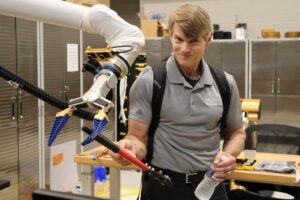
In an effort to reduce human exposure to hazardous materials, the RAD Lab is collaborating with Los Alamos National Laboratory (LANL) on a glovebox project. These are sealed chambers equipped with integrated gloves, enabling LANL employees to handle materials safely without exposure to hazardous substances—specifically radioactive materials. The RAD Lab is developing a robotic arm to handle these materials; however, Dr. Ambrose emphasizes that for safety purposes, human operators must remain involved in the process, either in an operational or supervisory capacity. While technically feasible, he does not believe it is best from an economic and time perspective to completely dismantle and rebuild the production line, so the robots need to integrate seamlessly into the existing workflow.
The plan is to start with the most challenging tasks, which typically occur at the end of the workflow, such as managing waste. In this scenario, both humans and robots collaborate to track discarded materials. The robot would help conduct volumetric scans, measure weight, and assess the radioactive dose to determine how much energy the material has absorbed from a radiation source. This process ensures that each piece of waste is properly labeled, cataloged, and accompanied by relevant data.
RoboBall
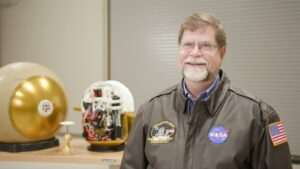
Dr. Ambrose emphasizes the importance of considering how robots will interact with humans as they evolve to meet specific needs, and that it is essential to identify tasks robots can perform effectively. In this case, the creation of RoboBall was borne from the need to navigate hazardous environments safely, such as water-filled craters at extremely low temperatures. Since exposing humans to these harsh conditions is unsafe, Dr. Ambrose designed RoboBall to be rolled into a crater from its edge. It was created to collect samples before using a rocket mechanism to launch them out of the crater, delivering them safely to scientists or astronauts outside.
RoboBall is a sealed sphere that contains only two motors, making it a simple yet effective machine. It features a durable outer layer made of thermally set polyurethane, the same material used in military tanks, which protects the robot against light-caliber rounds and allows it to withstand harsh environments. This layer is also flexible, which improves RoboBall’s capabilities and allows it to be pressurized. Currently, RoboBall is controlled by two separate controllers, and the lab is actively working to optimize switching between them for better performance.
The RAD Lab is also working on various other projects, including a Robotic Space Simulator for spacecraft docking and the HAND project, which seeks to design and build the next generation of humanoid robotic hands. But no matter what the project is, the RAD Lab is dedicated to advancing robotics through innovation.
At the forefront of developing technologies that enhance our interaction with machines, the RAD Lab is committed to pushing boundaries and exploring new possibilities. The cutting-edge work being led by Dr. Ambrose not only shows the lab’s dedication to technological advancement but also plays a crucial role in strengthening national security—Dr. Ambrose’s contributions and those of his team are essential to ensuring a safer, more secure future.