By Katherine Hollen
The Texas A&M Engineering Extension Service (TEEX) is all about one thing: saving lives. Home to numerous centers and training facilities, TEEX strives to prepare people for emergencies, which is a top priority in the nuclear security industry. Nuclear workers need not only to work to prevent disasters, but also to be ready to act and quickly develop practical solutions to any problems that do arise. TEEX’s capabilities uniquely position them to do just that, helping nuclear and other professionals train for emergencies.
The Emergency Operations Training Center
One facility that trains managers, supervisors, and other officials is the Emergency Operations Training Center (EOTC). The EOTC focuses on total immersion, using classrooms to simulate emergency scenarios. Participants get to experience different roles, practicing working in command, operations, planning, logistics, and admin/finance positions as if they were in a command post or an emergency operations center during various crises.
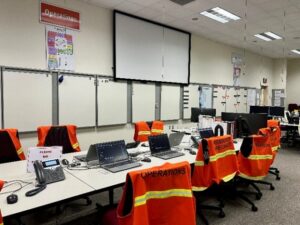
Bill Dozier, an Associate Division Director at TEEX’s Emergency Service Training Institute (ESTI), describes the process, “We start them off in the morning pretty easily with something like a car crash. But by the end, a plane may crash into their stadium during the Super Bowl.” However, Dozier says, no matter what the scenario, “It is the same process, and that is the beauty of the system. It is the same process that they are used to back home, and so they come here, and they get immersed in the scenario.”
Most training at the EOTC spans several days. Classrooms typically have 45 participants and 15 instructors to help guide them. Scenarios can last for hours, and the instructors follow a script for each, which they can speed up or slow down to train the group in the best possible way. Then, after each scenario, there is a debriefing in which instructors highlight key learning moments and discuss what went well and how people can improve.
One of Dozier’s favorite parts is watching how people progress. Participants may be nervous or hesitant at first, but he says, “By the last day, a lot of them really get into it. And the coolest thing about it is you watch them start to solve their own problems without the instructors.”
In addition to classrooms, the EOTC features a public information broadcast room. In this space, officials and supervisors can work on their media communication. Equipped with a podium, bright lights, real cameras, and a mock reporter asking questions, participants get practice speaking outside their comfort zones. Because the cameras can record, participants can also review their responses to gain better insights into their performance.

Disaster City
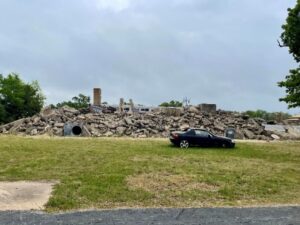
TEEX plays a crucial role in emergency responder training through its innovative facility, Disaster City. This unique training ground transforms wreckage from cars, planes, buildings, and more into realistic scenarios that responders might encounter in real-life disasters. Here, responders learn how to save individuals trapped in crushed vehicles after a parking garage collapse or manage the aftermath of train collisions.
The idea for Disaster City was born after the Oklahoma City bombing in 1995. When Oklahoma called for help, Texas realized there were no rescue teams in place for heavy structural collapses. Recognizing the urgent need for these teams, Dozier explains, “They built this area for training, and there are a bunch of different buildings we call props that simulate different scenarios” for the rescue teams that come to Disaster City.
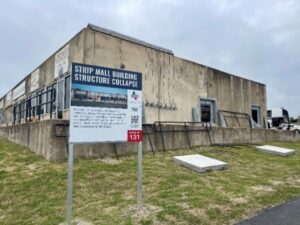
Not only do human emergency responders come from all over the world to train in Disaster City, but so do canine emergency responders. Search-and-rescue canine teams learn to accurately track and locate individuals trapped beneath thick rubble and concrete. Volunteers hide in tunnels carved through the rubble pile, allowing the dogs to practice tracking their scent as it rises through the concrete. “They indicate where the scent is strongest, which lets the rescuers know to tunnel down there and find people,” says Dozier.
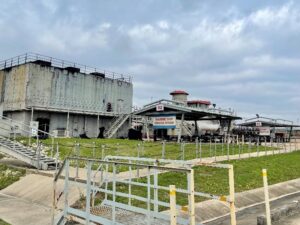
The TEEX Brayton Fire Training Field
The TEEX Brayton Fire Training Field features over 100 different training stations for emergency responders. Firefighters, emergency medical service personnel, hazmat workers, and others from around the world come here for training.
Serving primarily as a live-fire training facility, thousands of public and volunteer firefighters receive training here. During this training, firefighters learn to extinguish various types of fires, whether they are chemical fires at process complexes or apartment fires in three-story buildings. Other types of fires include bulk storage facilities, railcars, warehouses, and more, ensuring a comprehensive training experience for all participants.
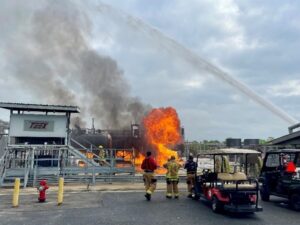
Marine firefighting training includes simulations of fires aboard ships and vessel emergency responses. Emergency medical services and rescue operations are conducted in the Emergency Medical Services Lab, where volunteers often act as disaster victims with simulated injuries. Additionally, hazmat scenarios involve using training props, such as pipelines, transport containers, and meter stations, to address issues such as gas leaks and chemical releases.
Helping National Security
As the nuclear industry faces unique challenges and potential emergencies, workers, managers, and executives must all be thoroughly prepared. The rigorous training TEEX offers is essential for safeguarding both personnel and the general public. Their ability to simulate high-pressure scenarios equips responders with the skills to navigate real-world crises efficiently and effectively.
National security also heavily relies on the preparedness of emergency management teams. TEEX’s comprehensive training fosters collaboration and coordination, enhances communication and operational efficiency during emergencies, and ultimately strengthens the nation’s resilience against threats.
By emphasizing crisis management, TEEX ensures that nuclear employees are well-prepared. Their training allows nuclear facilities to operate safely while being equipped to mitigate risks, thereby maintaining national security.